AI · Prompt Architecture
Translating the plan
How the JSON prompt becomes sentences for T5 and keywords for CLIP.
Why translate
Flux.2 Klein and Flux.3 Klein read the plan as it is, because their encoder is a language model. Older models read differently. SDXL works with CLIP only; Flux.1 dev and Flux.1 Krea dev work with two encoders at once, CLIP-L and T5. For them, the plan is translated.
CLIP was trained to match images with short descriptions, much like the alt text under a photo: “woman in red coat”, “modern kitchen interior”. These are not sentences but terms. CLIP doesn’t understand grammar or relationships between words; it recognises terms and weights them, with early terms counting more than late ones. One CLIP pass holds 77 tokens, roughly 50 to 60 words.
T5 is a language model. It reads sentences, understands what is subject and what is secondary, and recognises how things relate to each other. In Flux.1 it processes up to 512 tokens, so full descriptions are no problem.
This gives two translations of the same plan: connected sentences for T5 and a condensed keyword list for CLIP. Flux.1 gets both, each in its own field. SDXL gets only the keywords.
Four rules
Translating doesn’t mean rewriting. The decisions are made in the plan, and four rules make sure they aren’t lost in translation.
1. Rank sets the order
What matters most in the plan comes first in the translation. With CLIP that is essential, because early terms count more. With T5 it orders the sentences.
2. Interactions stay in one sentence
What only arises between two elements, such as the facade reflected in the paint, is not split across two sentences. For CLIP a relationship can only be approximated, as a compound term like “facade reflections on side panels”.
3. What you want to see gets its own sentence
T5 weights by role in the sentence. The subject comes through more strongly than what sits in a subordinate clause. “Natural daylight that pours in through floor-to-ceiling windows” makes the windows a side matter, and they then tend to be missing from the image. So important things get their own sentence.
4. Prohibitions are redirected
CLIP reads “no people” as “people”. So prohibitions have no place in the keyword list. With SDXL they move into the negative prompt. Flux.1 has no effective negative prompt; there, only the positive description in the T5 sentence remains.
Prose for T5
The starting point is prompt 2 from the previous page, the Porsche in grey metallic in front of the white facade.
+ Show prompt 2 (JSON)− Hide prompt 2 (JSON)
{
  "scene": "Quiet SoHo street, New York, early morning, empty, no people",
  "subjects": [
    {
      "description": "Vintage Porsche 911, blank license plate",
      "color": "warm light-grey metallic, black wheels with polished rims",
      "position": "lower half of frame, parked at the curb parallel to the building",
      "action": "parked"
    }
  ],
  "background": "White cast-iron storefront, columns framing tall shop windows that faintly mirror the street, lowest flight of a fire escape at the top edge, worn grey cobblestones",
  "lighting": "Soft, even overcast daylight, no hard shadows; facade reflects as broad, calm highlights on the side panels",
  "style": "Photorealistic, natural muted colors",
  "camera": {
    "angle": "three-quarter view",
    "distance": "medium shot",
    "focus": "Sharp focus on the front of the car",
    "lens-mm": 85,
    "f-number": "f/5.6"
  },
  "constraints": "No text, lettering, logos or signs anywhere"
}
The translation follows the plan without adding anything. The car, as the only subject, opens the text, with colour, wheels and position. The second sentence takes over the camera block. Then come the background and the cobblestones, each in its own sentence. Light and reflection stay together in one sentence, because the reflection only arises from both. Mood, style and the prohibitions come at the end.
t5xxl
A vintage Porsche 911 in warm light-grey metallic with black wheels and polished rims is parked at the curb, parallel to the building, filling the lower half of the frame. The car is seen in a three-quarter view as a medium shot, photographed with an 85mm lens at f/5.6, with sharp focus on the front of the car. Behind it rises a white cast-iron storefront in SoHo, New York, its columns framing tall shop windows that faintly mirror the street, the lowest flight of a fire escape at the top edge. Worn grey cobblestones cover the street. Soft, even overcast daylight without hard shadows; the white facade reflects as broad, calm highlights on the car's side panels. It is early morning, and the street is quiet and empty. Photorealistic, natural muted colors. The license plate is blank, with no text, lettering, logos or signs anywhere.
Keywords for CLIP
For CLIP the same plan is condensed further. Sentences become terms, and the order follows the rank. What drops out are relationships that can’t be put as a term, and the prohibitions.
clip_l
vintage Porsche 911, warm light grey metallic, black wheels, polished rims, three-quarter view, medium shot, parked at curb, white cast-iron storefront, SoHo New York, columns, tall shop windows, fire escape, worn grey cobblestones, soft overcast daylight, facade reflections on side panels, early morning, empty street, 85mm, f/5.6, photorealistic, natural muted colors
For SDXL this list is the positive prompt. The prohibitions from constraints go into the negative prompt:
Negative prompt (SDXL only)
people, text, lettering, logo, sign, watermark
Three models, one plan
Flux.1 Krea dev and Flux.1 dev get both translations, the prose in the t5xxl field, the keywords in the clip_l field. Both run with the same values and the same seed, so that only the model makes the difference.
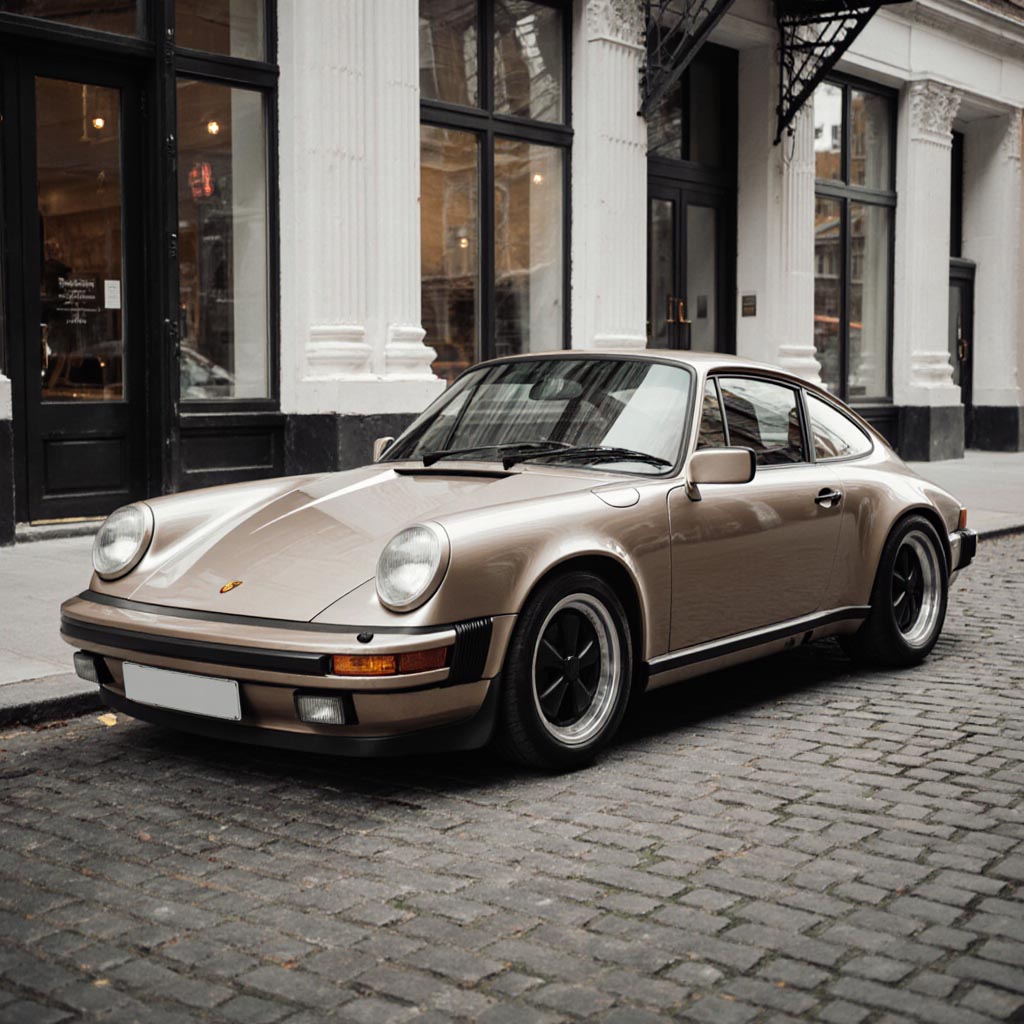
Flux.1 Krea dev · 1024 × 1024 · guidance 3.5 · 25 steps · Seed 416505903984901
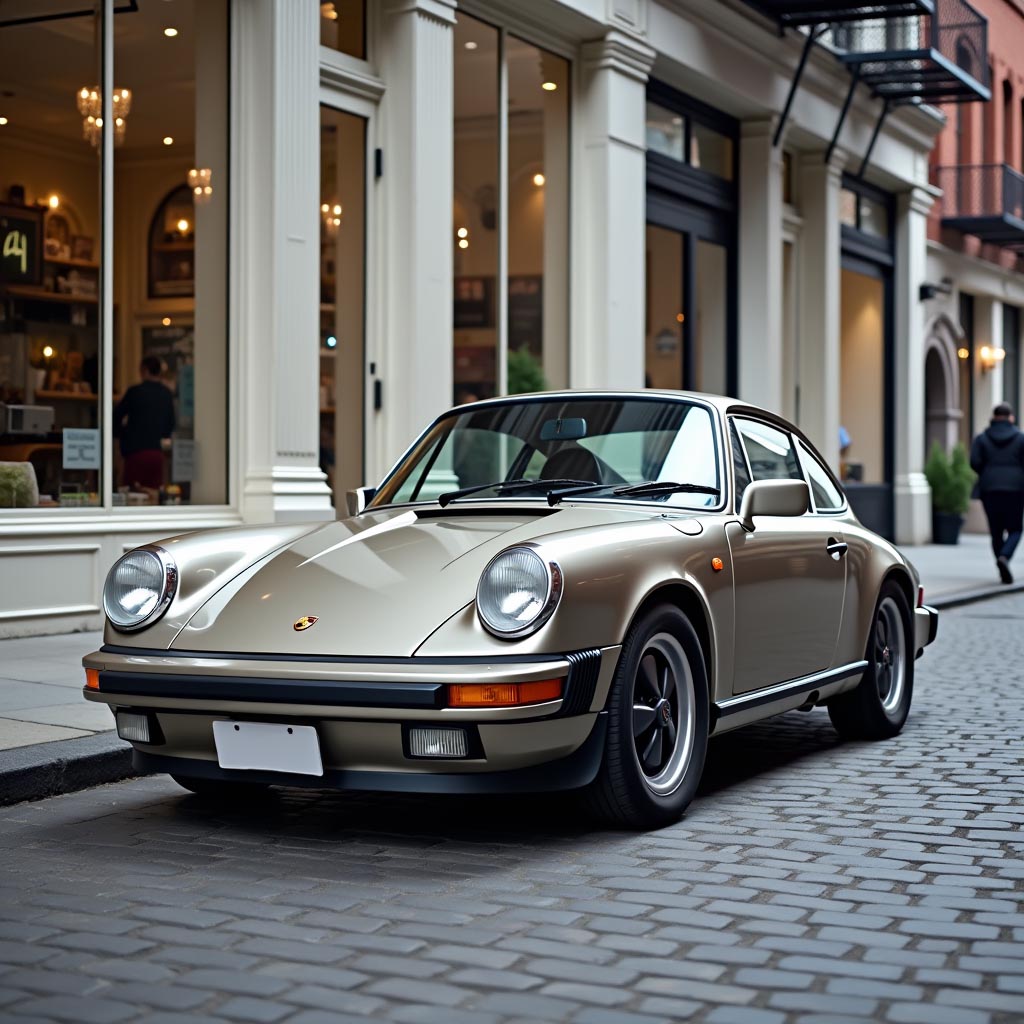
Flux.1 dev · 1024 × 1024 · guidance 3.5 · 25 steps · Seed 416505903984901
With the same settings, the image from Flux.1 Krea dev looks clearly more photographic. Flux.1 dev delivers the smooth, saturated look familiar from many AI images. That is my impression, and it matches everything I have done with both models so far.
Something else is more revealing. Although scene, prose and keywords call for an empty street, Flux.1 dev puts people in the image, one on the sidewalk, one in the shop. A sign even glows in the window. That is rule 4 in practice: Flux.1 has no negative prompt, and “no people” in a sentence is only a weak hint. Even “empty” isn’t enough here. A sidewalk explicitly described as “empty sidewalk” and shop windows with “dark, unlit interiors” would be the positive version.
SDXL gets only the keyword list and the negative prompt. On the first run it parked a second Porsche on the sidewalk in the background. So the translation had to be tightened. The empty street moves forward and is weighted slightly, “single car” is added, and the negative prompt now contains “other cars, traffic, modern car”. “second car” wouldn’t have been enough, because CLIP can’t count. “blank license plate” also comes back. It had dropped out of the list during condensing; it was in the plan.
SDXL, positive prompt (tightened)
vintage Porsche 911, (single car:1.2), blank license plate, warm light grey metallic, black wheels, polished rims, three-quarter view, medium shot, parked at curb, (empty street:1.2), white cast-iron storefront, SoHo New York, columns, tall shop windows, fire escape, worn grey cobblestones, soft overcast daylight, facade reflections on side panels, early morning, 85mm, f/5.6, photorealistic, natural muted colors
SDXL, negative prompt (tightened)
people, text, lettering, logo, sign, watermark, license plate numbers, other cars, traffic, modern car
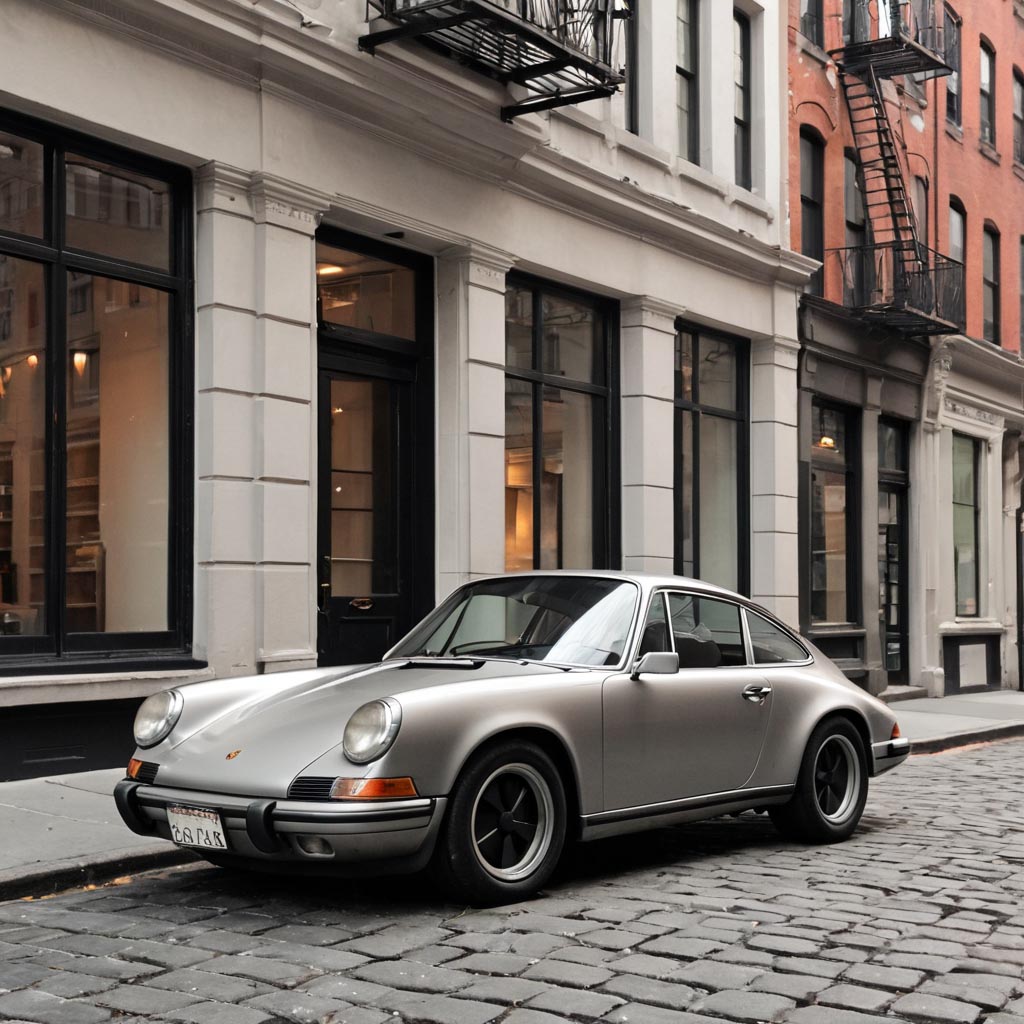
SDXL · Juggernaut XL · 1024 × 1024 · cfg 4 · 30 steps · dpmpp_2m · karras
The second car is gone. The licence plate still carries lettering, although “blank license plate” is in third place and “license plate numbers” is in the negative prompt. Here the keyword list reaches its limit: a blank plate doesn’t seem to be a term CLIP can tell apart from a lettered one.
On the other hand, SDXL gets the model year most accurately. The slim chrome bumpers belong to the 911 of the early seventies.
Paint and facade, in prose
On the previous page, hardly anything moved in Flux.2 Klein and Flux.3 Klein when paint and facade changed. The same change, this time as a translation for Flux.1 Krea dev: matte paint, black facade, reflection removed. Everything else is word for word the same, including the seed.
t5xxl, matte
A vintage Porsche 911 in matte grey with black wheels and polished rims is parked at the curb, parallel to the building, filling the lower half of the frame. The car is seen in a three-quarter view as a medium shot, photographed with an 85mm lens at f/5.6, with sharp focus on the front of the car. Behind it rises a worn black cast-iron storefront in SoHo, New York, its columns framing tall shop windows that faintly mirror the street, the lowest flight of a fire escape at the top edge. Worn grey cobblestones cover the street. Soft, even overcast daylight without hard shadows. It is early morning, and the street is quiet and empty. Photorealistic, natural muted colors. The license plate is blank, with no text, lettering, logos or signs anywhere.
clip_l, matte
vintage Porsche 911, matte grey, black wheels, polished rims, three-quarter view, medium shot, parked at curb, worn black cast-iron storefront, SoHo New York, columns, tall shop windows, fire escape, worn grey cobblestones, soft overcast daylight, early morning, empty street, 85mm, f/5.6, photorealistic, natural muted colors
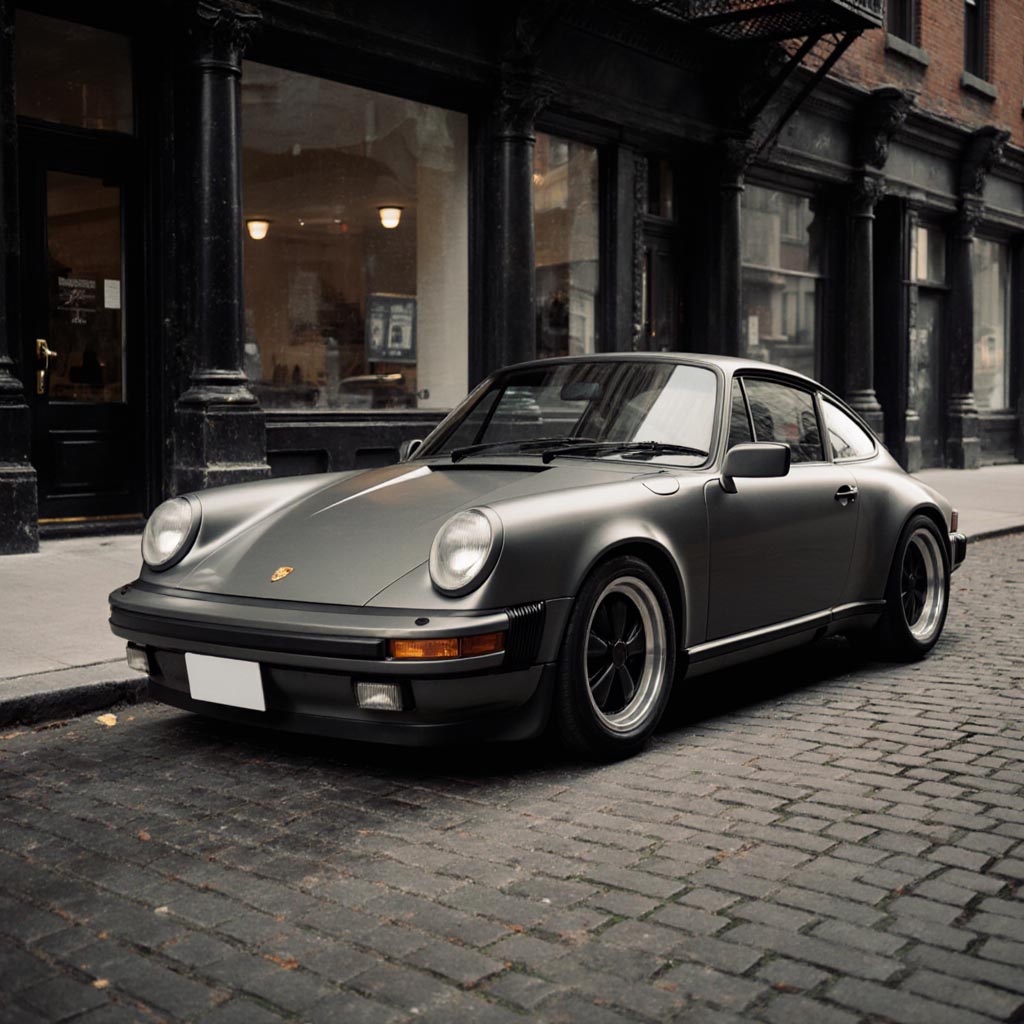
Flux.1 Krea dev · 1024 × 1024 · guidance 3.5 · 25 steps · Seed 416505903984901 · left glossy, right matte
The car stays almost in place; viewpoint and angle hold. But the background rebuilds itself: columns and windows sit differently, the fire escape has moved. In Flux.2 Klein and Flux.3 Klein the facade also kept its structure; only its colour changed. This fits my experience that the sentences of running text influence each other more than the fields of a JSON prompt. It is not a clean comparison, though, because besides the format, the model changes too.
What gets lost in translation
Every translation loses something, and the simpler the encoder, the more. In prose, the separation of fields is lost: what sits side by side in the JSON is woven together in the text. Bounding boxes, with which Flux.3 Klein places an element at a specific spot, have no equivalent in Flux.1 and SDXL. There, only the description in words remains, such as “in the lower half of the frame”.
In the keyword list, even more is lost. Relationships can only be hinted at as compound terms, and whatever comes after the 77th token barely gets through. The plan still remains the foundation. It says what may be sacrificed first when condensing: whatever has the lowest rank.
My favourite for RAY-L
Across all three pages, Flux.1 Krea dev has the most photographic look for me, even compared with Flux.2 Klein and Flux.3 Klein. That is an impression from many images, not a measurement. Its weakness lies elsewhere: because it reads prose, composition is hardest to control precisely here. Change one detail and the background easily rebuilds itself.
This weakness disappears when the composition doesn’t come from the prompt at all. In a RAY-L workflow, a Blender scene sets camera, perspective and geometry, and the model takes on what it does best: light, material and atmosphere. That is why Flux.1 Krea dev is my preferred model for workflows with RAY-L and Blender.
Settings
SDXL with Juggernaut XL. The positive prompt is the keyword list. Individual terms can be weighted: (floor-to-ceiling windows:1.3) strengthens, (fog:0.8) weakens. The useful range is 0.7 to 1.4; beyond that the result becomes unstable. If an element is missing, check the order first, then weight. The negative prompt stays short, six to ten terms, and contains only what actually shows up as a problem. Long stock lists from SD1.5 days restrict Juggernaut XL more than they help. Positive and negative prompts each have their own token budget. ComfyUI splits longer prompts into several 77-token chunks that are read separately, so the most important things belong in the first chunk. In the KSampler: cfg 4 to 5, 30 steps, sampler dpmpp_2m, scheduler karras.
Flux.1 dev and Flux.1 Krea dev. The CLIPTextEncodeFlux node has two text fields, clip_l for the keywords and t5xxl for the prose, plus a guidance value that sets how closely the model follows the prompt. For Flux.1 dev, 3.5 is the standard. For Flux.1 Krea dev, 4.0 and 28 to 32 steps have worked well in my tests, but the images on this page use the Flux.1 dev values for comparison. The cfg value in the KSampler must be 1 for both; any higher value works against the built-in guidance distillation and degrades the image. For the same reason there is no effective negative prompt. In the KSampler: 20 to 25 steps, sampler euler, scheduler simple.