AI · Prompt Architecture
Building the plan
One subject, three passes: how a JSON prompt grows field by field.
The idea
A Porsche 911 from the seventies, parked in front of one of the cast-iron facades in SoHo. Early morning, the street still empty, the sky overcast, the light soft. The car is the centre of attention, the facade sets the place, the cobblestones the ground.
That is how I would note the image before a shoot: a few sentences, a feel for place and light. Now this note becomes the form.
The first draft
The first prompt is deliberately short. Seven fields; that is all it takes to begin.
{
  "scene": "Quiet SoHo street, New York, early morning, empty, no people",
  "subjects": [
    {
      "description": "Vintage Porsche 911, warm light-grey metallic, black wheels with polished rims, blank license plate",
      "position": "lower half of frame, parked at the curb parallel to the building",
      "action": "parked"
    }
  ],
  "background": "White cast-iron storefront, columns framing tall shop windows that faintly mirror the street, lowest flight of a fire escape at the top edge, worn grey cobblestones",
  "lighting": "Soft, even overcast daylight, no hard shadows; facade reflects as broad, calm highlights on the side panels",
  "style": "Photorealistic, natural muted colors",
  "camera": {
    "angle": "three-quarter view",
    "focus": "everything sharp, deep depth of field"
  },
  "constraints": "No text, lettering, logos or signs anywhere"
}
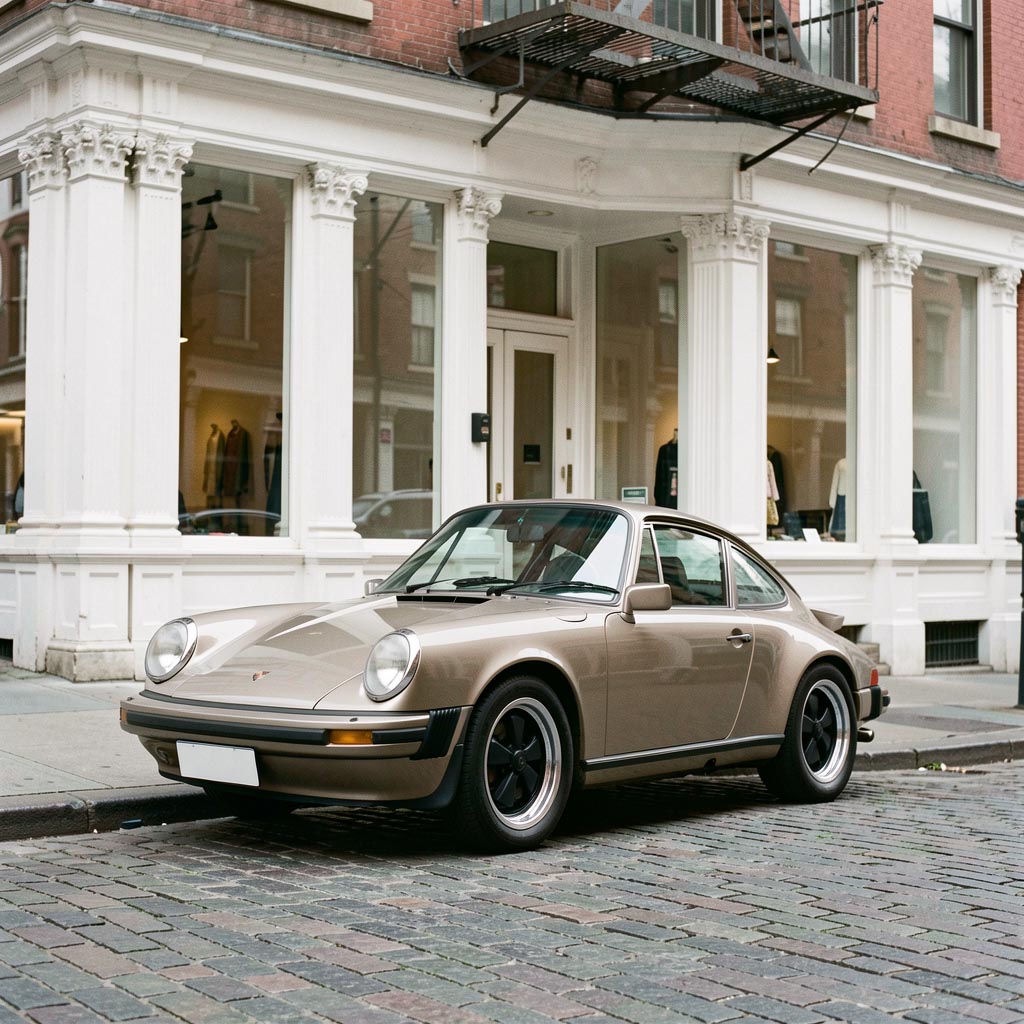
Flux.2 Klein 9B · 1024 × 1024 · 4 steps · Seed 68735976491074 · Prompt 1
The order doesn’t follow the eight areas from the previous page but the schema Black Forest Labs documents for FLUX.2: scene, subjects, background, lighting, style and camera, plus a field for what should stay out of the image. The eight areas are still all there. Subject and materials sit with the car, the environment in the background, time of day and mood in the scene, composition and technique with the camera. Lighting and style have fields of their own.
There is no numeric rank here. It lies in the placement: the car is the only subject, everything else is background.
Checking field by field
The result is not a bad image. The car is right, so are the facade, the cobblestones and the soft light. What isn’t quite right is the perspective. The camera is aligned cleanly, the film plane parallel to the facade, nothing converges. But the car itself looks slightly distorted, the front a little overemphasised, the shape stockier than a 911 is. It is a small deviation, yet it makes the image look less photographic than it could.
Lay the eight areas over the prompt as a checklist and the cause is quickly found. The camera field contains only “three-quarter view” and the focus. Viewpoint, distance and focal length appear nowhere. The model made these decisions itself, and it chose the most likely. This is exactly the case from “The empty field”: where the AI interprets too freely, the field concerned is usually too thinly described.
Expanding the camera field
In the second pass, the camera gets what a photographer would set anyway: shot size, point of focus, focal length and aperture. Along the way I moved the colour out of the car’s description into a field of its own. The changed lines are highlighted.
{
  "scene": "Quiet SoHo street, New York, early morning, empty, no people",
  "subjects": [
    {
      "description": "Vintage Porsche 911, blank license plate",
      "color": "warm light-grey metallic, black wheels with polished rims",
      "position": "lower half of frame, parked at the curb parallel to the building",
      "action": "parked"
    }
  ],
  "background": "White cast-iron storefront, columns framing tall shop windows that faintly mirror the street, lowest flight of a fire escape at the top edge, worn grey cobblestones",
  "lighting": "Soft, even overcast daylight, no hard shadows; facade reflects as broad, calm highlights on the side panels",
  "style": "Photorealistic, natural muted colors",
  "camera": {
    "angle": "three-quarter view",
    "distance": "medium shot",
    "focus": "Sharp focus on the front of the car",
    "lens-mm": 85,
    "f-number": "f/5.6"
  },
  "constraints": "No text, lettering, logos or signs anywhere"
}
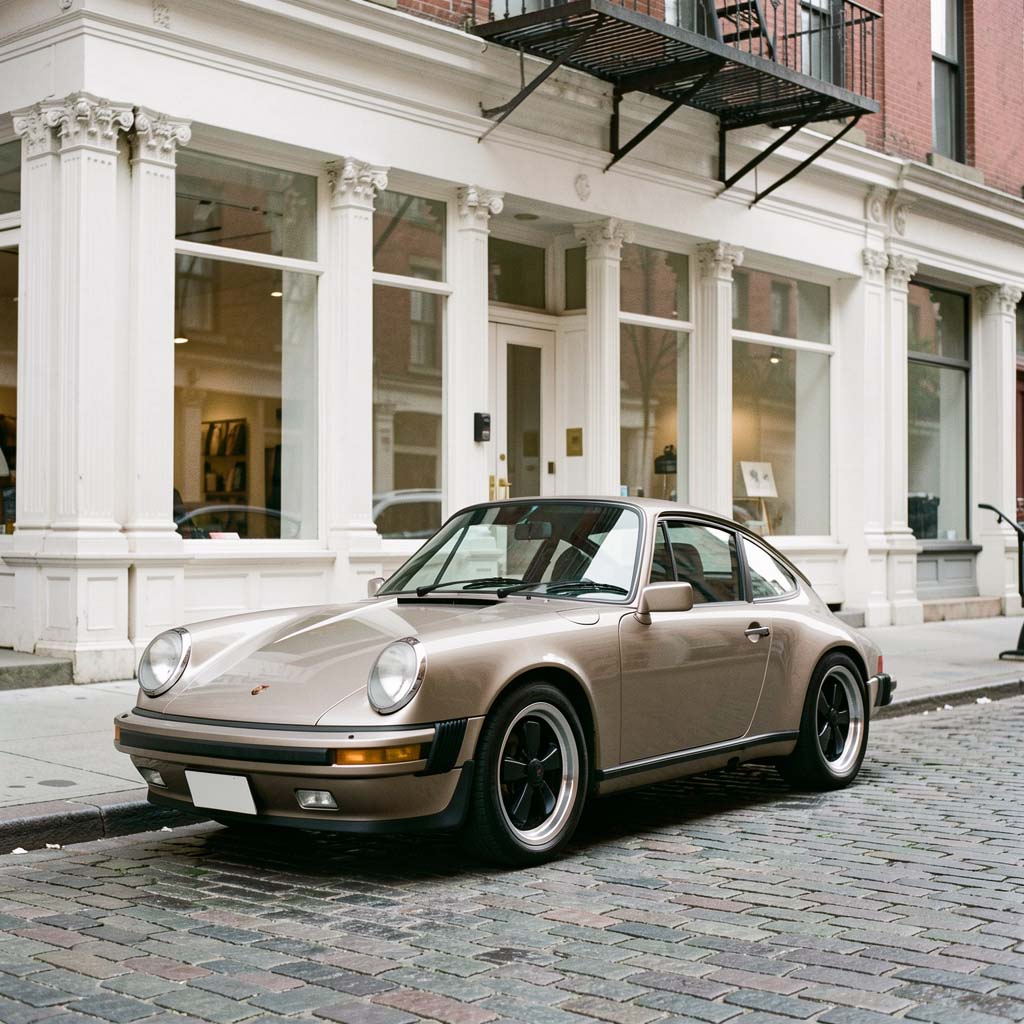
Flux.2 Klein 9B · 1024 × 1024 · 4 steps · Seed 68735976491074 · left prompt 1, right prompt 2
The camera alignment stays the same. What changes is the perspective of the car: it is calmer and more compressed, the proportions look natural, the way you know it from a longer focal length at a slightly greater distance. The difference is small and best seen with the slider. But it decides whether the image looks like photography.
Which single value caused this can’t be read from this pair, because more than one changed. It was the expanded camera block as a whole.
Change two fields, the rest holds
In the third pass I change two things: the paint becomes matte grey, the facade black and worn. Everything else stays, including the seed.
{
  "scene": "Quiet SoHo street, New York, early morning, empty, no people",
  "subjects": [
    {
      "description": "Vintage Porsche 911, blank license plate",
      "color": "matte grey, black wheels with polished rims",
      "position": "lower half of frame, parked at the curb parallel to the building",
      "action": "parked"
    }
  ],
  "background": "worn black cast-iron storefront, columns framing tall shop windows that faintly mirror the street, lowest flight of a fire escape at the top edge, worn grey cobblestones",
  "lighting": "Soft, even overcast daylight, no hard shadows; facade reflects as broad, calm highlights on the side panels",
  "style": "Photorealistic, natural muted colors",
  "camera": {
    "angle": "three-quarter view",
    "distance": "medium shot",
    "focus": "Sharp focus on the front of the car",
    "lens-mm": 85,
    "f-number": "f/5.6"
  },
  "constraints": "No text, lettering, logos or signs anywhere"
}
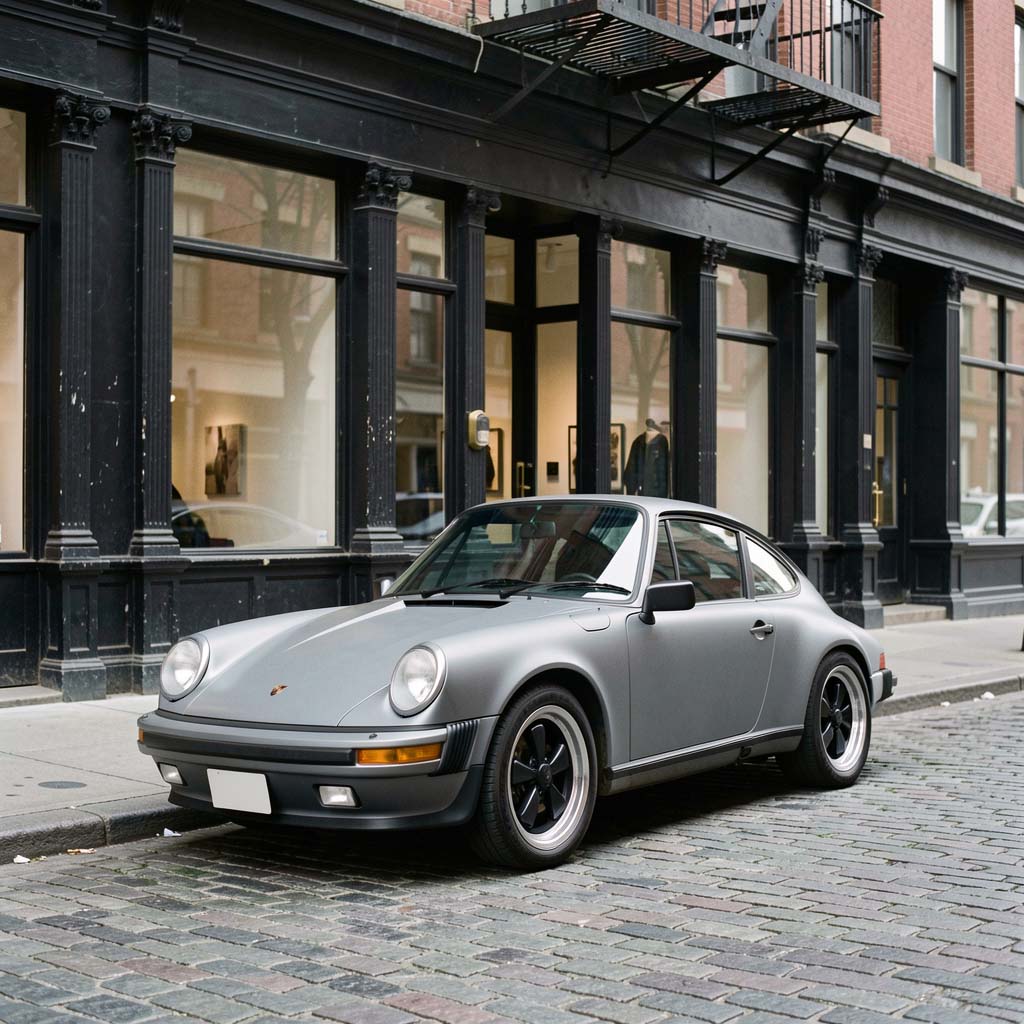
Flux.2 Klein 9B · 1024 × 1024 · 4 steps · Seed 68735976491074 · left prompt 2, right prompt 3
The car stands almost exactly in place. Viewpoint, angle and proportions, the position of the fire escape, the cobblestones: everything stays, only paint and facade are new. This matches my experience that the parts of a JSON prompt influence each other little. This one pair is not proof. But it shows what it feels like in practice: you change one field without rolling the dice on the whole image.
This only holds as long as model, resolution, steps and seed stay the same. Change any of them and the composition changes too.
Where the plan tears
Two spots still don’t hold. The first is in the lighting field. Since the first pass it has said that the facade reflects as broad, calm highlights on the side panels. With metallic paint that was right. But matte paint barely reflects, and a black facade throws back no bright light. In the third image the reflection is gone. The model resolved the contradiction in favour of the material.
The reflection is an interaction. It only arises between facade, light and paint. If it sits only in the lighting field, it stays there when the material changes and contradicts it. So whoever changes a field has to check which interactions depend on it.
The second is the constraints field. It forbids text, logos and signs, and yet the crest sits on the bonnet in all three images. In the first there is even a small sign in the window. Prohibitions alone are weak. In my experience it works better to describe what you want positively: “empty sidewalk” instead of “no pedestrians”, “plain, unbadged bodywork” right with the car instead of “no logos”. The prohibition can stay as well. The scene already does this: “empty, no people” first describes what the street looks like and only then forbids.
The same plan in Flux.3 Klein
Flux.3 Klein reads JSON just as directly as Flux.2 Klein. So the first attempt is prompt 2 unchanged, without the prompt upsampler and at 1408 × 1408, the minimum resolution Flux.3 Klein needs.
{
  "scene": "Quiet SoHo street, New York, early morning, empty, no people",
  "subjects": [
    {
      "description": "Vintage Porsche 911, blank license plate",
      "color": "warm light-grey metallic, black wheels with polished rims",
      "position": "lower half of frame, parked at the curb parallel to the building",
      "action": "parked"
    }
  ],
  "background": "White cast-iron storefront, columns framing tall shop windows that faintly mirror the street, lowest flight of a fire escape at the top edge, worn grey cobblestones",
  "lighting": "Soft, even overcast daylight, no hard shadows; facade reflects as broad, calm highlights on the side panels",
  "style": "Photorealistic, natural muted colors",
  "camera": {
    "angle": "three-quarter view",
    "distance": "medium shot",
    "focus": "Sharp focus on the front of the car",
    "lens-mm": 85,
    "f-number": "f/5.6"
  },
  "constraints": "No text, lettering, logos or signs anywhere"
}
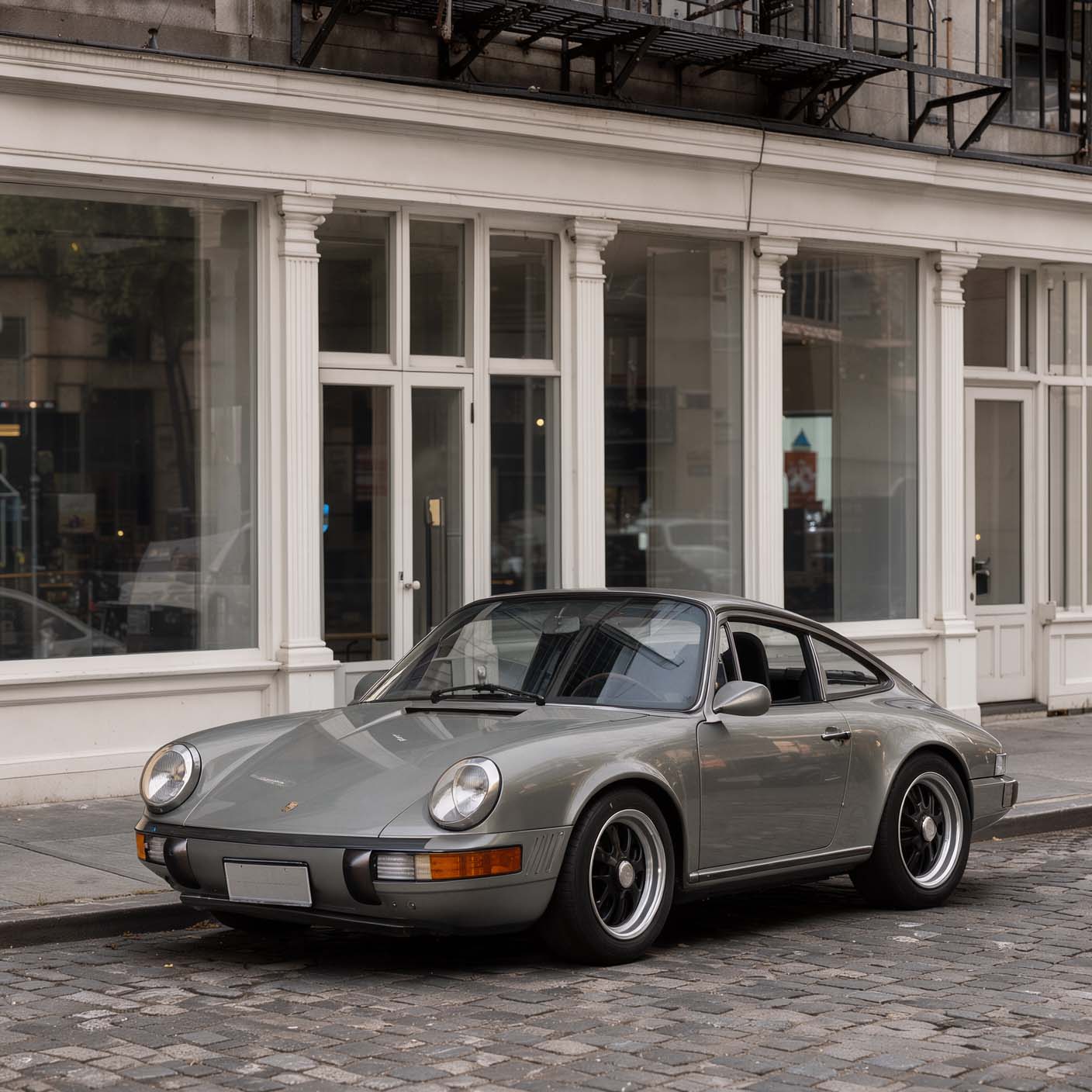
Flux.3 Klein · 1408 × 1408 · 12 steps · Seed 192230550104121 · attempt 1
The car is recognisable as a 911, but the proportions are wrong. The front is too long and too bulbous, wheels and body don’t fit together. Other seeds and 1024 × 1024 didn’t make it better.
This time the check leads to the car’s field. “Vintage Porsche 911” is enough for Flux.2 Klein, but not for Flux.3 Klein. Which field is too thin also depends on which model is reading.
That Flux.3 Klein generally needs more precise descriptions is my impression from a number of subjects, not a statement from Black Forest Labs. The standard workflow supports it: it includes a prompt upsampler, a separate language model of several gigabytes that turns a short prompt into a long, detailed text. Nobody builds that in without reason. The upsampler makes decisions, but only where the prompt sets nothing, and it writes them out before the image is made. That confirms what these pages are about: the model works best when every decision is described. I still leave it off, because it dissolves JSON prompts into prose and in doing so also blurs what was already set. Instead, I write the missing descriptions into the plan myself. So in the second attempt the prompt names model and year.
{
  "scene": "Quiet SoHo street, New York, early morning, empty, no people",
  "subjects": [
    {
      "description": "Porsche 911 Carrera, 1973, blank license plate",
      "color": "warm light-grey metallic, black wheels with polished rims",
      "position": "lower half of frame, parked at the curb parallel to the building",
      "action": "parked"
    }
  ],
  "background": "White cast-iron storefront, columns framing tall shop windows that faintly mirror the street, lowest flight of a fire escape at the top edge, worn grey cobblestones",
  "lighting": "Soft, even overcast daylight, no hard shadows; facade reflects as broad, calm highlights on the side panels",
  "style": "Photorealistic, natural muted colors",
  "camera": {
    "angle": "three-quarter view",
    "distance": "medium shot",
    "focus": "Sharp focus on the front of the car",
    "lens-mm": 85,
    "f-number": "f/5.6"
  },
  "constraints": "No text, lettering, logos or signs anywhere"
}
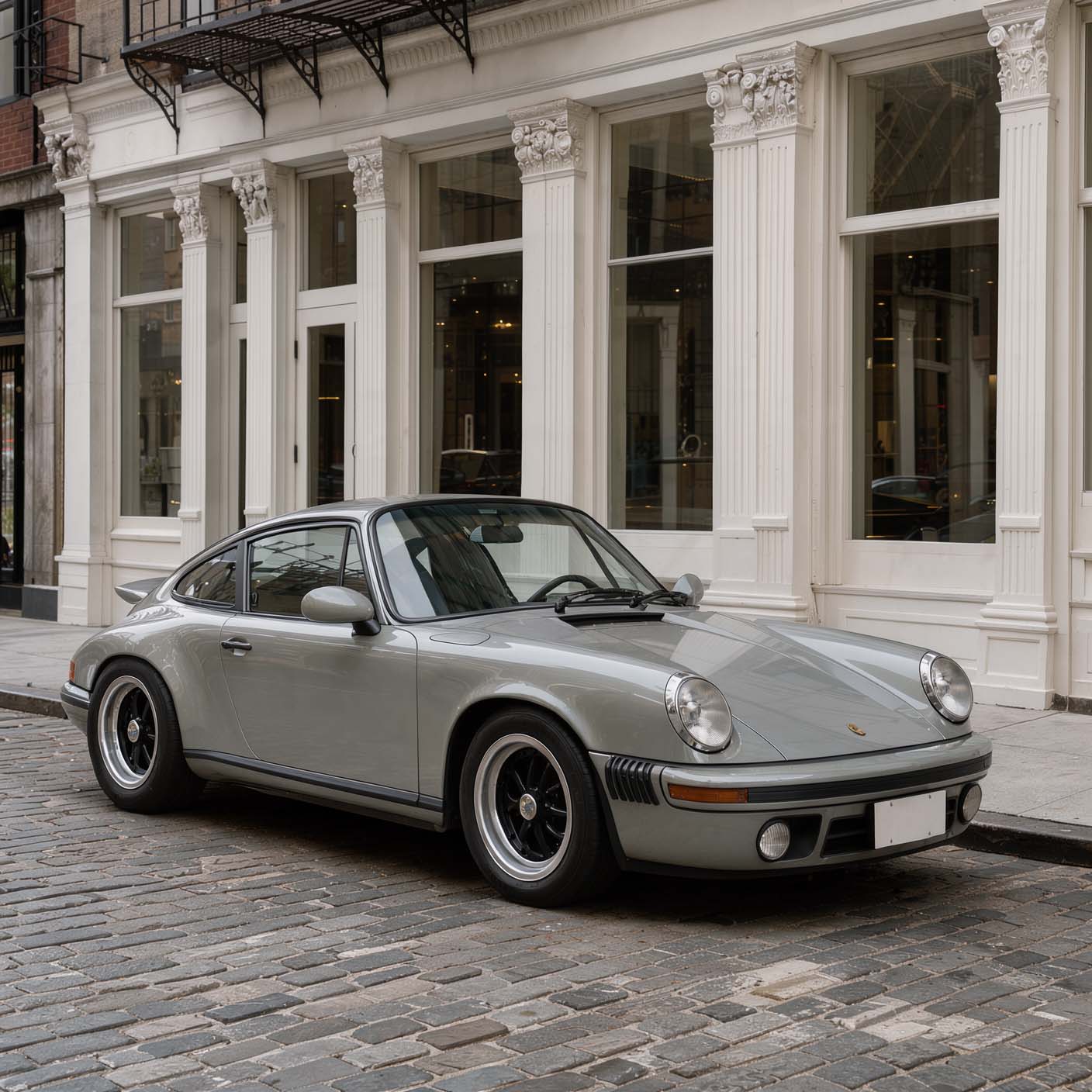
Flux.3 Klein · 1408 × 1408 · 12 steps · Seed 192230550104121 · attempt 2
Now the car is right. That it is seen from the other side is not a mistake. “three-quarter view” doesn’t say from which side. Flux.2 Klein chose one, Flux.3 Klein the other. That, too, is an empty field, in a value you thought was set.
The third attempt makes the same changes as with Flux.2 Klein: matte paint, black facade. This time the reflection is also removed from the lighting field, because with matte paint and a dark facade there is none.
{
  "scene": "Quiet SoHo street, New York, early morning, empty, no people",
  "subjects": [
    {
      "description": "Porsche 911 Carrera, 1973, blank license plate",
      "color": "matte-grey, black wheels with polished rims",
      "position": "lower half of frame, parked at the curb parallel to the building",
      "action": "parked"
    }
  ],
  "background": "worn black cast-iron storefront, columns framing tall shop windows that faintly mirror the street, lowest flight of a fire escape at the top edge, worn grey cobblestones",
  "lighting": "Soft, even overcast daylight, no hard shadows",
  "style": "Photorealistic, natural muted colors",
  "camera": {
    "angle": "three-quarter view",
    "distance": "medium shot",
    "focus": "Sharp focus on the front of the car",
    "lens-mm": 85,
    "f-number": "f/5.6"
  },
  "constraints": "No text, lettering, logos or signs anywhere"
}
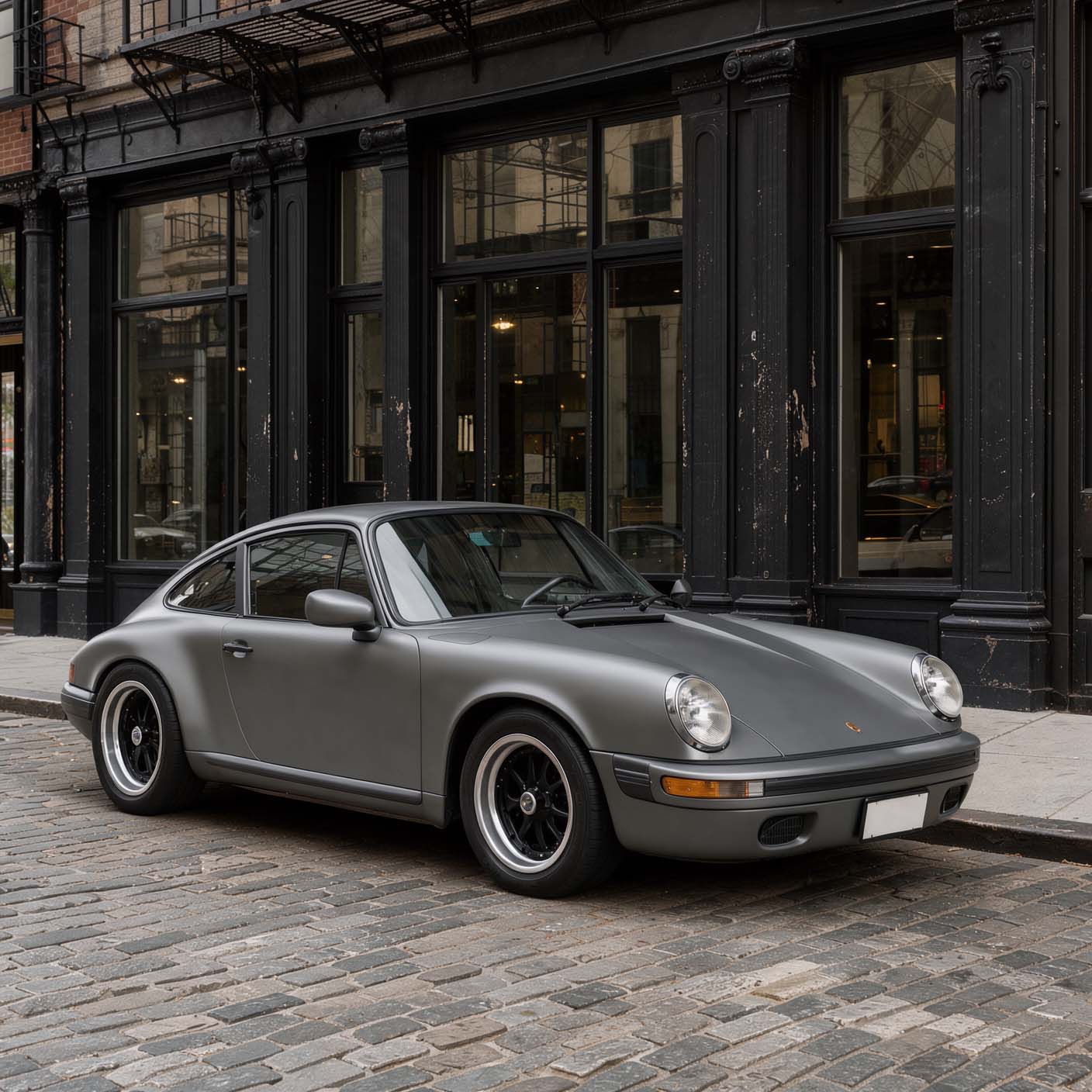
Flux.3 Klein · 1408 × 1408 · 12 steps · Seed 192230550104121 · attempt 3
The composition holds here too. Paint and facade are new; viewpoint, angle and car stay. So Flux.3 Klein behaves like Flux.2 Klein when fields change.
The plan stands
Three passes, each one working on a specific spot instead of rewriting the whole prompt. Flux.2 Klein and Flux.3 Klein read the plan as it is, even if each needs more description in a different place. Other models need a translation into prose or keywords. The next page shows how.